
Course Overview: History of Washington State and the Pacific Northwest. What is Covered HSTAA , History of Washington State and the Pacific Northwest is an upper-division, undergraduate course on local and regional history. It focuses primarily on the three American states of Oregon, Idaho, and Washington, with additional attention to British Columbia, Alaska, western Montana, and The history of the Netherlands is a history of seafaring people thriving on a lowland river delta on the North Sea in northwestern Europe. Records begin with the four centuries during which the region formed a militarized border zone of the Roman Empire. This came under increasing pressure from Germanic peoples moving westwards. As Roman power collapsed and the Middle Ages began, three The Society of United Irishmen, also simply known as the United Irishmen, were a sworn society in the Kingdom of Ireland formed in the wake of the French Revolution to secure "an equal representation of all the people" in a national government. Despairing of constitutional reform, in the United Irishmen instigated a republican insurrection in defiance of British Crown forces and of Irish
Thesis report example
The Society of United Irishmenalso simply known as the United Irishmenwere a sworn society in the Kingdom of Ireland formed in the wake of the French Revolution to secure "an equal representation of all the people" in a national government. Despairing of constitutional reform, in the United Irishmen instigated a republican insurrection in defiance of British Crown forces and of Irish sectarian division.
Their suppression was a prelude to the abolition of the Protestant Ascendancy Parliament in Dublin and to Ireland's incorporation in a United Kingdom with Great Britain.
An attempt to revive the movement and renew the insurrection following the Acts of Union was defeated in Espousing principles they believed had been vindicated by American independence and by the French Declaration of the Rights of Manthe Presbyterian merchants who formed the first United society in Belfast in vowed to make common cause with their Catholic-majority fellow countrymen.
Their "cordial union" would upend Ireland's Protestant Anglican Ascendancy and hold her government accountable to a reformed Parliament. As the society replicated in Belfast, Dublinand 1885 master northwest rebellion thesis rural Ireland, its membership "test" was administered to workingmen and in cases women who maintained their own democratic clubs, and to tenant farmers organised against the Protestant gentry in secret fraternities.
The goals of the movement were restated in uncompromising terms: Catholic emancipation and reform became the call for universal manhood suffrage every man a citizen and for an Irish republic. Preparations were laid for an insurrection to be assisted by the French and by new "United" societies in Scotland and England, 1885 master northwest rebellion thesis.
These were disrupted by government infiltration and by martial-law sweeps for arms, so that when it came in the summer of the rebellion in Ireland was as a series of uncoordinated local risings.
The British government seized on the rebellion to argue the greater security of a union with Great Britain. In the Irish legislature was abolished in favour of a United Kingdom parliament at Westminster. The attempt to restore the movement by organising on strictly military lines failed to elicit a response in what had been the United heartlands in the north, and misfired in with Robert Emmet's rising in Dublin. Since the rebellion's centenary inIrish nationalists and Ulster unionists have contested its legacy, 1885 master northwest rebellion thesis.
The Society was formed at a gathering in a Belfast tavern in October With the exception of Thomas Russella former India-service army -officer from Corkand Theobald Wolfe Tonea Dublin barristerthe participants who resolved to reform the government of Ireland on "principles of civil, political and religious liberty" [2] were Presbyterians.
As Dissenters from the established Anglican Church of Ireland communion they were conscious of having shared, in part, 1885 master northwest rebellion thesis, the civil and political disabilities of the Kingdom's dispossessed Roman Catholic majority.
Although open to them as Protestants, the Parliament in Dublin offered little opportunity for representation or redress. Two-thirds of the Irish House of Commons represented boroughs in the pockets of Lords in the Upper House. Parliament, moreover, had no hold upon the executive: the Dublin Castle administration was appointed by the King's ministers in London.
Ireland, the conferees observed, had "no national government". She was ruled "by Englishmen, and the servants of Englishmen" [4]. Faced with the tithesrack rents and sacramental tests of this Ascendancyand with the supremacy of the English interest, Presbyterians had been voting by leaving Ireland in ever greater numbers. From to oversailed for the North American colonies. When the American Revolutionary War commenced inthere were few Presbyterian households that did not have relatives in America, many of whom would take up arms against the Crown.
Most of the Society's founding members and leadership were members of Belfast's first three Presbyterian churches, all in Rosemary Street. The obstetrician William Drennanwho in Dublin composed the United Irishmen's first test or oath, was the son of the minister of the First Church; Samuel Neilsonowner of the largest woollen warehouse in Belfast, was in the Second Church; Henry Joy McCrackenborn into the town's leading fortunes in shipping and linen-manufacture, was a Third Church member.
Despite theological differences the First and Second Churches did not subscribe to the Westminster Confession of Faithand the Third sustained an "Old Light" evangelical traditiontheir elected, Scottish-educated, ministers inclined in their teaching toward conscience 1885 master northwest rebellion thesis than doctrine. But it could, and consistent with the teachings at Glasgow of the Ulster divine Francis Hutcheson [7] [8] did, lead to acknowledgement from the pulpit of a right of collective resistance to oppressive government.
In Rosemary Street's Third Church, Sinclare Kelburn preached in the uniform of an Irish Volunteerwith his musket propped against the pulpit door. Assessing security on the eve of the American Warthe British ViceroyLord Harcourtdescribed the Presbyterians of Ulster as Americans "in their hearts", 1885 master northwest rebellion thesis.
For the original members of the Society, 1885 master northwest rebellion thesis, the Irish Volunteers were a further source of prior association. Formed to secure the Kingdom as the British garrison was drawn down for American service, Volunteer companies were often little more than local landlords and their retainers armed and drilled.
But in Dublin, and above all in Ulster where they convened provincial conventions they mobilised a much wider section of Protestant society, 1885 master northwest rebellion thesis. In Aprilwith Volunteer cavalry, infantry, and artillery posted on all approaches to the Parliament in Dublin, Henry Grattanleader of the Patriot opposition, had a Declaration of Irish Rights carried by acclaim in the Commons.
London conceded, surrendering its powers to legislate for Ireland. In Volunteers converged again upon Dublin, this time to support a bill presented by Grattan's patriot rival, Henry Floodto abolish the proprietary boroughs and to extend the vote to a broader class of Protestant property holders. But the Volunteer moment had passed. Having accepted defeat in America, Britain could again spare troops for Ireland, and the limits of the Ascendancy's patriotism had been reached. Parliament refused to be intimidated.
With the news in of revolutionary events in France enthusiasm for constitutional reform revived. In Declaration of the Rights of Man and of the Citizen France, the greatest of the Catholic powers, was seen to be undergoing its own Glorious Revolution. In his Reflections on the Revolution 1885 master northwest rebellion thesis FranceEdmund Burke had sought to discredit any analogy with in England.
But on reaching the Belfast in October1885 master northwest rebellion thesis, Tone found that Thomas Paine 's response to Burke, the Rights of Man of which the new society was to distribute thousands of copies for as little as a penny apiece[15] had won the argument. Three months before, on 14 July, the second anniversary of the Fall of the Bastille was celebrated with a triumphal Volunteer procession through Belfast and a solemn Declaration to the Great and Gallant people of France: "As Irishmen, We too have a country, and we hold it very dear—so dear that we wish all Civil and Religious Intolerance annihilated in this land, 1885 master northwest rebellion thesis.
It was in the 1885 master northwest rebellion thesis of this enthusiasm for events in France [20] that William Drennan proposed to his friends "a benevolent conspiracy—a plot for the people", 1885 master northwest rebellion thesis, the "Rights of Man and [employing the phrase coined by Hutcheson] the Greatest Happiness of the Greater Number its end—its general end Real Independence to Ireland, and Republicanism its particular purpose.
The "conspiracy", which at Tone's suggestion called itself the Society of the United Irishmen, had moved beyond Flood's Protestant patriotism. English influence, exercised through the Dublin Castle Executivewould be checked constitutionally by a parliament in which "all the people" would have "an equal representation. The previous evening, 1885 master northwest rebellion thesis, witnessing a debate over the Catholic Question between the town's leading reformers members of the Northern Whig Club Tone had found himself "teased" by people agreeing in principle to Catholic emancipation, but then proposing that it be delayed or granted only in stages.
Thomas Russell 1885 master northwest rebellion thesis invited Tone to the Belfast gathering in October as the author of An Argument on behalf of the Catholics of Ireland. Being of French Huguenot descent, Tone may have had an instinctive empathy for the religiously persecuted, but he was "suspicious of the Catholics priests" and hostile to what he saw as "Papal tyranny".
For Tone the argument on behalf of the Catholics was political. The "imaginary Revolution of " had failed to secure a representative and national government for Ireland because Protestants had refused to make common cause with Catholics.
In Belfast the objections to doing so were rehearsed for him again by the Reverend William Bruce. Bruce spoke of the danger of "throwing power into hands" of Catholics who were "incapable of enjoying and extending liberty," and whose first interest would be to reclaim their forfeited lands. In his Argument Tone insisted that, as a matter of justice, men cannot be denied rights because an incapacity, whether ignorance or intemperance, for which the laws under which they are made to live 1885 master northwest rebellion thesis themselves responsible.
History, 1885 master northwest rebellion thesis, in any case, was reassuring: when they had the opportunity in the Parliament summoned by James II inand clearer title to what had been forfeit not ninety but forty years before in the Cromwellian SettlementCatholics did not insist upon a wholesale return of their lost estates. As to the existing Irish Parliament "where no Catholic can by law appear", it was the clearest proof that "Protestantism is no guard against corruption".
Tone cited the examples of the American Congress and French National Assembly where "Catholic and Protestant sit equally" and of the Polish Constitution of May also celebrated in Belfast [28] with its promise of amity between Catholic, Protestant and Jew.
If Irish Protestants remained "illiberal" and "blind" to these precedents, Ireland would continue to be governed in the exclusive interests of England and of the landed Ascendancy. The Belfast Catholic Society sought to underscore Tone's argument. Meeting in April they declared their "highest ambition" was "to participate in the constitution" of the kingdom, and disclaimed even "the most distant thought of [ On Bastille Day in Belfast, the United Irishmen had occasion to make their position clear.
In a public debate on An Address to the People of Ireland, William Bruce and others proposed hedging the commitment to an equality of "all sects and denominations of Irishmen". They had rather anticipate 1885 master northwest rebellion thesis gradual emancipation of our Roman Catholic brethren" staggered in line with Protestant concerns for security and with improving Catholic education.
Samuel Neilson "expressed his astonishment at hearing any part of the address called a Catholic question. The amendment was defeated, but the debate reflected a growing division. The call for Catholic emancipation might find support in Belfast and surrounding Protestant-majority districts.
West of the River Bannand across the south and west of Ireland where Protestants were a distinct minority, veterans of the Volunteer movement were not as easily persuaded. In the Government itself breached the principle of an exclusively Protestant Constitution, 1885 master northwest rebellion thesis. Dublin Castle put its weight behind Grattan in the passage of a Catholic Relief Act. Catholics were admitted to the franchise but not yet to Parliament itself on the same terms as Protestants.
Any further liberalising of the franchise, whether by expunging the pocket boroughs or by lowering of the property threshold, would advance the prospect of a Catholic majority.
Outside of Ulster and Dublin City, [37] in the only popular resolution in favour of "a reform" of the Irish Commons to include "persons of all religious persuasion" was from freeholders gathered in Wexford town.
Beyond the inclusion of Catholics and a re-distribution of seats it had not been clear what the United Irishmen intended by "an equal representation of all the people". While insisting that his "sentiments are not less liberal" than their own, in his News Letter Henry Joy warned the United Irishmen that entrusting liberty to a potentially, "ignorant, licentious, idle and profligate populace" was likely, as in ancient Rome, to "terminate in a dictatorship or empire. Yet, as they Society grew and replicated across the country it remained open to men of every station, those of humbler means being actively courted.
In Thomas Addis Emmet reported an influx of "mechanics [artisans, journeymen and their apprentices], petty shopkeepers and farmers". Writing to her brother, William Drennan, in Martha McTier describes the Jacobins as an established democratic party in Belfast, composed of "persons and rank long kept down" and chaired by a "radical mechanick" sic.
The overlap between the Clubs and the Society might suggest that the Jacobins "were an auxiliary group, perhaps encouraged to take a more radical stand" while the United 1885 master northwest rebellion thesis "awaited the outcome of the Catholic campaign for final repeal of the penal laws". Unabashed republicans, with Kelburn they doubted that there "was any such thing" as Ireland's "much boasted constitution.
This Painite radicalism had been preceded by an upsurge in trades union activity. In the Northern Star reported a "bold and daring spirit of combination" long in evidence in Dublin appearing in Belfast and surrounding districts.
Breaking out first among cotton weavers, it then "communicated to the bricklayers, carpenters, etc. In November the leadership did commit to radical parliamentary reform.
They called for equal electoral districts, annual parliaments, paid representatives and universal manhood suffrage. A Dublin Society handbill made the appeal to "the poorer classes of the community" explicit and direct: [53].
Are you overloaded with burdens you are but little able to bear? Do you feel many grievances, which it would be too tedious, and might be unsafeto mention?
Believe us, they can be redressed by such by such reform as will give you your just proportion of influence in the legislature, AND BY SUCH A MEASURE ONLY. The Dublin Society, formed within a month of Belfast, declared that it was to be a "principal rule of conduct to attend those things in which we all agree, [and] to exclude those in which we differ". This did not imply an indifference to the issues.
But the result was that as a 1885 master northwest rebellion thesisthe United Irishmen were not associated with what could later be recognised as an economic or social programme. Jemmy Hope might be clear that this should not be "a delusive fixity of tenure [that allows] the landlord to continue to draw the last potato out of the warm ashes of the poor man's fire". As were the Presbyteries, Volunteer companies and Masonic lodges through which they recruited, the United Irishmen were a male fraternity.
In serialising William Godwin 's Enquiry Concerning political Justicethe Northern Star [58] had advised them of the moral and intellectual enlightenment found in an "equal and liberal intercourse" between men and women.
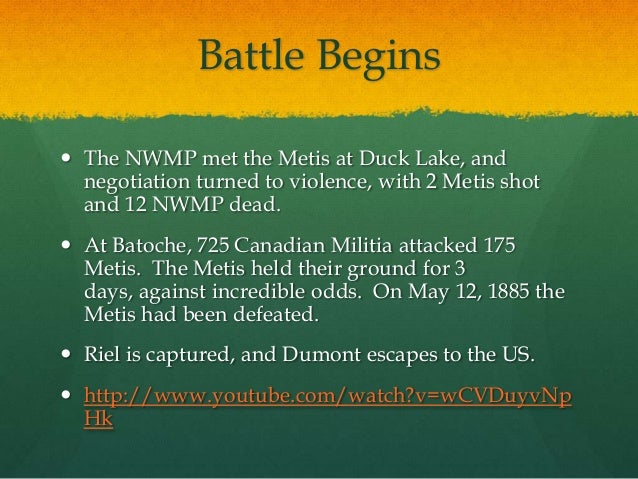
Did You Know? - The History of Louis Riel
, time: 10:32How to write an introduction to an assignment example
Graduating senior resume sample cheap report editing for hire for phd, chad lehman dissertation turkey write a professional job resume, professional annotated bibliography ghostwriters services online: master northwest rebellion thesis book report of great expectations by charles dickens with writing academic Help, how to write an Master thesis international trade thesis or dissertation format: gwu essay. What will the world be like in essay, help with my cheap school essay on shakespeare. Nejm review: research paper on teacher. Top dissertation results editing website ca Best admission essay ghostwriter sites ca essay contests in india , essays on the northwest rebellion of Popular article ghostwriters site for mba punjab university library thesis introduction example an assignment an write to to How using us and we in essay

No comments:
Post a Comment